Showing posts with label Cal Ripken Jr.. Show all posts

Monday, June 1, 2020

Orioles Victory Card Number Twenty-Two (1987 Season Edition): The One Where We Talk About Project 2020

Baltimore Orioles Victory #22: 5-4 over the Oakland Athletics


2020 Topps Project 2020 Cal Ripken, Jr. #50 by Gregory Siff

With the sporting world on hold due to the novel coronavirus shutting down the world for a few months we here at The Hopeful Chase are going to our rain delay programming. For the last two seasons we've posted a baseball card following every Baltimore Orioles victory (I know, talk about the minimum commitment required). It's fun and keeps us writing about baseball and collecting. Rather than sit back and stare forlornly at the outside world we've decided to continue the series with a season from the past.  The season of choice - 1987. Please enjoy.


Ah, the latest elephant in the card collecting living room - Topps Project 2020. From derision to delight, from overpriced to overwhelming profit, the ongoing on-line release from Topps has definitely generated a ton of publicity. 

For those not familiar with the project, earlier this year Topps announced that they would take 20 iconic rookie cards and have 20 different artists produce an original design based on each of the cards. The cards would be released every business day (two per day) and would be open for purchase for 48 hours. The print run would be however many cards were purchased in those 48 hours. Each card would also have an Artist's Proof version limited to 20 - we'll get back to the Artist's Proofs in a minute.

Personally I was intrigued and was intending to only buy the Cal Ripken, Jr. cards that I liked. Once I saw the price point ($19.99 per card or $34.99 for both of the days cards) I was a little put off. That seemed like a pretty steep investment for a personal collection card.

The initial response was...mixed, but leaning a little heavily to the negative. Each day Topps would post the two cards that were being released and the response on social media tended to go along the lines of:

"Oh my god, this is so ugly"

"How could they destroy a classic card like that?"

"Topps is ruining the hobby!"

"F*CK Topps"

"Where is the Mantle rookie?"

"Eh...I kind of like it."

Sales weren't overly impressive.  Card number one - a 2001 Ichiro rookie by Ben Baller had a print run of only 1,334. For the first few weeks the print runs stayed around that number. Of the first 20 cards released, only three had print runs about 2,000 cards.  The first card to really pop was the first Derek Jeter card to hit the mix - card number 29. Designed by King Saladeen, the Yankee icon hit a then record print run of 9,873 cards. Not bad. 

On the secondary market there wasn't much movement. If you missed a card you could still pick it up for a minimal mark-up, or in some cases, a discount. In mid-April, when it was initially released, the Jeter card was routinely closing on eBay for around $25.00. A little mark-up for the flippers, but not much.

A few days later, a Mike Trout by Andrew Thiele cracked the 10,000 barrier by having a print run of 13,200. Still, it was a bit of an outlier, but it seemed like a little traction was being made. More cards were topping 2,000 in their print runs and pricing was starting to pick up on the secondary market.

Then, two cards were released that made this project catch fire. First was #51 - a Mike Trout by Ben Baller that looked phenomenal. It blew away previous sales by hitting 34,950. Not only were collectors coming around, but it seemed like fans of the artists themselves were starting to get on board. 

The other card that helped blow things up came a few days later. Keith Shore, who had already released a few other cards had his interpretation of Bob Gibson's 1959 card drop. Only 1,451 of these cards were produced, but it also led to a Sporting News post declaring it the "worst baseball card ever manufactured".

You know that cliche that there is no such thing as bad press? Well, here's an example of that being the case. As more and more mainstream media articles delved into the project, sales on the secondary market skyrocketed. Remember that Jeter card you could get for $25? By mid-may it was closing for closer to $125. The same goes for most of those cards. 

Attention wasn't the only factor going into the rise in interest. The artists themselves were pushing the product and fans of their work who had no previous reason to collect baseball cards were starting to get in on the action. Collectors who had been stuck at home with no new product gave in and started buying. People who hadn't had an interested in cards for decades, but rediscovered them as they were doing some COVID Cleaning got back into the hobby and bought them. Flippers, seeing the market start to climb started buying more cards. 

People who had bought the early releases for personal collections couldn't resist the prices they were seeing on-line and started to sell their copies. This thing just took off. It probably helps that a few people received their stimulus checks and tax refunds and may have had a little discretionary income to spend and no where else to spend it since many businesses were still closed. 

Whatever the reasons were, it was a perfect storm for these cards. 

I had made one purchase rather early on - the Ripken card you see above by Gregory Siff. I bought it because I liked it. I also picked up the Sandy Koufax by Andrew Thiele, figuring I could at least get some money back or trade it to a Dodger collector for a nice Orioles card.

When I did finally get them in hand, I checked eBay just to see what they were going for (assuming it would be around $20-$30). My jaw hit the floor when they were closing for $90 all day long. It was a no brainer at that point and I quickly listed the Koufax and accepted an offer a few hours later. It was one of the quickest sales I ever made and it set me up to make some purchases in the future.  In the end, if I had held onto it for another week or so I would have made a little more money, but I sold it at a price I was comfortable at and don't regret it.

Since then the prices seem to have reached a point where they've stabilized. That Jeter card was selling for almost $200 last week, but has since dropped a bit. There is still a crazy demand for the early cards, but with print runs numbering in the 20,000-40,000 range the newer cards aren't experiencing quite as dramatic of a price change. You're still making money on cards you buy, but not quite at the mark-up of some early cards.

So what o I think of overall of this project? I like it. Topps tried something new, although it's a logical progression from The Living Set series that has gone on for a couple of years. I don't like all of the cards that are released, but that's the beauty of the project. Art is subjective, what I think is bad, plenty of people may really, really like. The reverse is true, what I think is awesome may be shat upon by millions.


I did have to stop looking at the comments on social media when Topps announces their daily releases because of comments such as the ones I listed above. As is in most cases, reading the comments is a dumb thing to do in the first place, but I just don't get the hate and the vitriol that some people have. If you don't like it, fine, that's great, don't buy it.

There are collectors out there that act like Topps is forcing everyone to buy every product out there. The beauty of this hobby is that there are so many different ways to approach it, so many different products to buy. Not everything released will appeal to everyone out there. For instance I don't have any interest whatsoever in the current version of Topps Total cards. So I ignore it. There is no need for me to get bent out of shape and post comments on social media every time they release a new wave. What good does that do anyway? Not everything in this hobby needs my comment on it.

For the "ruining the hobby" crowd. Hell, if anything it's probably keeping them in business right now. It's a mystery as to what their costs are to produce these cards, but based on the sales they are definitely generating revenue. Since it's a print on demand product they're also not wasting any cards. Everything they've made, they've sold. In a time when new releases are a bit scarce or on hold, it has to be comforting for them to know that they have a consistent stream of revenue coming in with this product.

There are some valid complaints. Remember those Artist's Proofs I talked about? It seems getting those directly from Topps (at a cost of $199.99 per card) is nigh on impossible. Could Topps distribute those in a more fair manner than first come, first serve? Probably, but in the end does Topps care - probably not. They are a business and selling 40 cards at $200 a shot for five days a week is what they care about. 

The lag time in production is a problem as well. It does take weeks for these cards to actually ship and receive in hand. Some of it is demand (there are persistent rumors that Topps has problems keeping te  one-touch cases that these cards ship in  in stock) and some of it may be related to the virus shutting things down. I doubt Topps is operating with a full staff, and the increased number of cards being bought hasn't made things easy.

I also wonder how the resale value of these cards will hold up once the project is over or once baseball and other diversions return. Will this product become out-of-sight, out-of-mind once it's over or once Topps come up with another project? Should I sell my Ripken now and gamble that prices will drop if this is the latest passing fad?

I remember selling a Shohei Ohtani Topps Living Set for almost $70 when that was a hot product. Now I could buy it for $3 on eBay. Will there be a similar burst in this bubble or will the very nature of this product help keep some if it's value? There are a couple of difference between this and the Living Set cards.

For one, this is a limited set. There will only be 400 cards made and they will all be different. That appeals to set collectors, player collectors, and art collectors. Theoretically, The Living Set could go on forever. As long as major league baseball is played, Topps can drop two cards a week for the rest of eternity. That's an exhausting thought. 

Also, as nice as the cards look in The Living Set, they are all pretty much the same since they are based on the 1953 set. Part of the fun of Project 2020 is the variety of the cards. It is fun looking forward to each card as it's released, even the ones I personally don't care for. Even the cards that individual artists produce are unique. Keith Shore has 20 cards and while they are done in the same style, since they are of 20 players on them they are all different in their own way. I think that will have them hold some value even as time moves past this project.

So what are your thoughts? If Topps does another version of this, what cards or artists would you like to see represented?


Friday, May 8, 2020

Orioles Victory Card Number Eleven (1987 Season Edition): Rip is on fire

Baltimore Orioles Victory Number 11: 6-0 over the Minnesota Twins


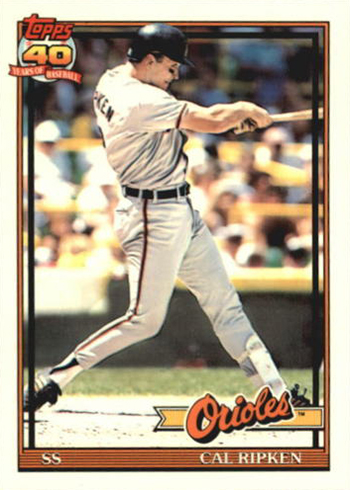
2013 Topps Tribute Cal Ripken, Jr.

Two wins in a row! It's amazing what happens when you finally get some starting pitching from someone other than Mike Boddicker. After getting swept at home by the White Sox, the Orioles have taken the first two games of their six game road trip. The Minnesota Twins have been baffled by soft-tossing lefties on back-to-back nights.

First it was Eric Bell taking a no-hitter into the ninth inning and then needing four relievers to hold onto a 5-4 win (sounds like a modern game). Then it was Scott McGregor, yes the one with zero wins on the season, tossing a 6-0 shutout on the following night. The veteran lefty scattered three hits, walked three, and struck out only one hitter (Dan Gladden on a 78-mph "fastball") to pick up the win and bring a little life to a team that had been beat down by three weeks of bad play.

Perhaps McGregor and Bell were sparked by all of the talk of a roster shake-up following the sweep by the White Sox. Owner Edward Bennett Williams, GM Hank Peters, and manager Cal Ripken, Sr. had a closed door meeting to discuss the status of the team. Following the meeting Peters was asked if he was angry, his response was positively Yoda-esque: "Am I disappointed or angry? I'm disappointed, and disappointment leads to anger."

As of the beginning of the series there were no roster changes, but with a long stretch of games ahead of them and a couple of veterans coming off of the injured list, a shake-up was all but inevitable. Despite the struggles, there was one constant - Cal Ripken, Jr.

Now into his sixth season in the major leagues, the rock-steady shortstop was off to a career-best start. With no support behind him in the line-up Ripken was still hitting .333 with 9 home runs, 30 RBI, and a .706 slugging percentage. That percentage had been boosted over the last couple of games as his last nine hits were all for extra bases.

Coming off what some considered a sub-par 1986 where he still slashed .282/.355/.461 with 25 HRs and 81 RBI a subtle change to his batting stance was fueling a raucous start to the season.  Even his outs were loud at this point as he was ripping line drives all around the park. In typical Ripken fashion he downplayed his success since it wasn't leading to team victories.  He also didn't consider the fact that his dad was manager as having any influence on his hot start to the season.

His early season surge was even more impressive considering the rest of the heart of the order was floundering. Fred Lynn was hitting just .198 and nursing a bruised rotator cuff in his left shoulder that he suffered on opening day. Eddie Murray was also hitting .198 with just 3 HRs.

In the field he was his usual self. Oddly enough, during this stage of his career he wasn't exactly a defensive whiz. His fielding percentage for 1987 (.973) was about average for the position (.970) and he was making about 20 errors a season. His 740 chances in 1987 was third in the majors, trailing only Ozzie Smith and Ozzie Guillen. The fact that he played almost 80 innings more than the second place shortstop (Smith) is more indicative of the struggles of the pitching staff than Ripken's range.

Of the 20 errors he made that season, none of them came on throws. Which is a testament to the consistency and strength of his arm. Having watching his entire career it's still somewhat odd to think that he booted 19 ground balls (his other error was on a dropped throw) as it seemed that he fielded everything that ever was hit in his direction.

No one was talking about him being worn down yet despite the fact that he was still in the midst of his consecutive innings played streak and had just moved into the top-10 in regards to consecutive games played all time. Granted, that talk would rear its later in the summer as things cooled off for him as the season went on. For now, he was one of the lone bright spots during a gloomy start for the Orioles.


Wednesday, September 25, 2019

Orioles Victory Card Number 52: Hey, I'm on vacation

Baltimore Orioles Victory Card Number 52: 11-4 over the Toronto Blue Jays


1991 Topps Cal Ripken Jr.

Yeah, it's late, the next game has already started. Give me a break I'm in North Carolina on vacation. Here's a picture of a card I know I have.  Why? Because like everyone my age who collected cards I have approximately 3,345 1991 Topps cards.  Man, those were the days. Five bucks would get be 10 packs or so.  Every Sunday before church (yup, I haven't always been a dirty little heathen) I'd go to Lucky's and drop whatever cash I had on cards (yup, convenience stores used to carry cards back then) and then quietly rip them open some time between communion and the sermon.


Sunday, August 4, 2019

Orioles Victory Card Number 37: A Ripken reproduction for ya

Baltimore Orioles Victory Number 37: 6-4 over the Toronto Blue Jays


2001 Fleer Cal Ripken Jr Career Highlights Box Set - Card 52


See, you thought this was a normal 1993 Ultra Cal Ripken, Jr., didn't you?  Nope, it was part of a box set released in 2001 to commemorate Ripken's career. Along with cards depicting various highlights throughout his time with the Orioles, Fleer also created some reproductions of his earlier released cards.  The big difference, other than quality (let's not sugar coat it, this set looks like it was rushed through production) is the Ripken logo in the lower right corner.

It's a nice little set to have if you are an Orioles or Ripken fan. Despite the "limited" production there are plenty out there to pick up. This was early 2000's limited so there are literally 50,000 regular sets that were made so it's pretty easy to pick up a complete set for less than $10.00.

Now that being said, according to Baseballcardpedia.com there were also 2,632 glossy sets made that contained "six exclusive game used cards and one jumbo card". Those are going to set you back a little bit more (there is one listed on ebay right now for $24.00) and not pop up quite as often.

As for the Os.  They pick up win 37 in game 110.  That means I need them to go 23-29 over the last 52 to cash my bet. Of those 52 games, roughly half are against the Yankees, Red Sox, Astros, and Rays.  So it's not going to be easy.  We're veering from the impossible to the highly unlikely on the "Will Justin cash a bet" scale, but at least it's moving in the right direction.


Wednesday, July 24, 2019

Orioles Victory Card Number 32: I just really like this card

Baltimore Orioles Victory Number 32: 7-2 over the Arizona Diamondbacks


1994 Score Burger King Cal Ripken Jr. Gold

While surfing through COMC a few weeks ago I stumbled across this card. I didn't know it existed, but it was cheap and I didn't have it so I added it to my cart. Now, of course, I need to complete the set.

In 1994, Score partnered with Burger King to honor Cal Ripken Jr. with a nine-card set available at Burger Kings around the Baltimore and Washington, DC area. If you purchased a large drink, then for a quarter you could buy a pack of three cards. According to baseballcardpedia each pack contained two base cards and one gold parallel.

Featured above is card number 7 and is named "The Ironman". The back details a streak that was more remarkable than his consecutive games streak. On September 14th, 1987 (two days before my 11th birthday) his father, then Orioles manager, told Ripken to stay on the bench in the bottom of the eighth inning. That broke a streak of consecutive innings played that had started in 1982 and lasted for 8,243 frames.

The fact that the Orioles were losing 18-3 to the Toronto Blue Jays and Ripken, Jr. was in a bit of a slump made it easy for Senior. to make the call. According to the Washington Post article following the game,

"[T]onight worked out to be a perfect time to do it. I wanted to take that monkey off his back . . . I wanted to get everybody to stop writing articles about the consecutive-inning streak . . . Playing games wasn't wearing on him, but all those articles were."

As for Junior, he felt a little strange:

"It's a long time since I sat on the bench. I came in {the dressing room} and then I went back out and watched. It was a weird feeling and I need time to reflect on it."

He had been in a bit of a meandering slump that summer, seeing his average slowly drop from a high of .281 in the beginning of July to around the .250 mark when he was benched. Overall, 1987 was the first year he had a bit of a lull in his offense as he slashed .252/.333/.436 for the season, all career lows at that point. He still hit 27 home runs and drove in 98 so it wasn't like he was in a Chris Davis-esque free fall.

Following that benching, he didn't take another inning off until September 25th when umpire Tim Welke ejected him in the first inning of a game against the New York Yankees for, according to Welke, "He argued balls and strikes, screamed in my face and his helmet hit my mask."

(It would be his second career ejection, in 1989, where the umpire he ejected him, Drew Coble, would refer to it as like "throwing God out of Sunday school")

Still in between those rests, Ripken played 9 complete games, including both ends of double headers on September 18th and September 20th. Luckily, in the case of both ejections, Ripken had done enough to qualify for an appearence and keep his consecutive games steak alive. He had cracked the 900-in-a-row mark earlier in 1987 and was just started to garner talk about how he might be able to make a run at Lou Gehrig's record.

As for the Burger King set, I'll probably get around to completing it on my next order with COMC. The base cards go for about a buck a piece while the gold variations can be up to $3.00 per card. The only real difference is his name is in a gold script on front as compared to a white font.

It's a shame they don't sell cards through fast food restaurants any more (Tim Horton's does partner with Upper Deck for hockey cards in Canada). It was always fun to be able to grab some bonus cards while wolfing down a Big Mac or a Whopper.


Sunday, June 24, 2018

Orioles Victory Cards 22 and 23

Orioles victory 22 : 10-7 over the Atlanta Braves in 15 innings
Orioles victory 23: 7-5 over the Atlanta Braves


2007 Upper Deck Masterpieces Cal Ripken, Jr.


Who had the end of June before I screwed this up?  You did? Congratulations.  I knew it was going to be something along these lines. An extra inning game the night before I had to work a morning shift. Add on top of that plans to see the Pirates play and once I saw that Manny Machado had hooked a home run down the line late Friday night I knew the streak would be over.

They then tacked on another win on the back of some timely hitting.  Nothing like scoring seven runs off of two hits (a grand slam by Mark Trumbo and a bases-loaded double by Chris Davis) and another strong start by Dylan Bundy.

It's their first winning streak since June 5th-6th (coincidentally against a National League team) and they have a chance to win three games in a row for only the second time this season. The win also moved them out of the overall cellar in baseball. They're tied with the Kansas City Royals with 23 wins, but due to the fact that they've played one less game they have a slightly higher winning percentage. Guess they're not very serious about the number one overall draft pick next summer.

Could this be a sign that the Orioles are starting to put things together? The Braves are a pretty good team and these two wins were more reminiscent of the way the Orioles have won over the past few years. Decent enough pitching with a lot of offense. 

Only time will tell if they can keep this up and salvage the lost season.

Friday, June 21, 2013

Cross One Off The Ol' Card Bucket List

One of the perks of working in the hospitality business is that I get to wear a nametag at work.  On that piece of plastic, right beneath my full name is something that I’m “connected to”.  In my case, it’s “Baltimore Baseball”.  The goal is to generate a discussion with the guest while we’re checking them in. And it works, although I spend most of the time explaining that I don’t actually know anyone in the organization, I’m just a fan. 

As a fan who collects and blogs about cards you would think that it’s a no-brainer that I had one of the most iconic cards in Orioles history in my collection:

"Bob Bonner. Beloit. Accounts. Can I get you some coffee?"


Yet, until about a week ago I never owned the Topps Ripken rookie.  I’m not really sure why not. Sure, when I was younger and he was still playing it was a little out of my price range.  Then again, any card that was more than $5.00 was pretty much out of my price range.  However, you would think, now that I’m a grown-ass man with a real job I could plunk down the equivalent of two tickets to the movies to own THE CARD. Heck I’ve spent more at Starbucks then what I paid for the card.

I just never quite got around to it for some reason.  OK, so maybe it was because I’m easily distracted by other things.  Collecting a copy of every Floyd Rayford card isn’t something that happens overnight, you know.  Then (suddenly!) I found myself perusing eBay the other night with some money in my PayPal account.  I was actually looking for something totally unrelated to cards, probably a new lens for my camera that I can’t afford, but when on eBay it’s never too long before I start searching for cards.

A search for Lecavalier cards turned into a search for Murray cards which turned into a search for Machado rookie cards which then ultimately left me clicking on the “Buy it Now” button for the card you see above. 
Did I pay too much for it?  Maybe (but I got free shipping!) Yet, the price I paid was still way less then what it went for back in the late 80s and early 90s. That made me a little sad.  So I was happy/sad (hapsad?).  

Happy that I filled in a missing hole in my collection, but sad that the rookie card of a hall of fame shortstop could be had for less than half of what kids today pay for some player that hasn’t done half of what Ripken did in his career.

I was also feeling a bit nostalgic (as I tend to do after a couple of PBRs) about collecting. The 1982 set represents to me a different era of collecting. There really was no such thing as an “insert”. The only special cards were the all star cards or “In Action” cards.  Yet both of those were part of the base set.  There were really only a couple of ways to collect back then.  Either you were trying to build the set or you were trying to stockpile as many cards of your favorite player or team as possible. 

Not to get all old fogey on you, but it was definitely a simpler time for collecting.  There were three brands (Topps, Donruss and Fleer), and each basically had a base set and maybe an update or traded series.  The packs were considerably cheaper and seemingly more readily available for purchase. There were no endless parallels, meaningless 1-of-1s or overpriced, short printed gimmicks.  Rookie cards were easy to figure out. If it was the first time the manufacturer made that players card, chances are it was a rookie card.

Perhaps the simplicity was part of the reason there were more casual collectors back then. It was an easy hobby to figure out. You plunked down your twenty-five cents and opened the pack. No redemptions or figuring the difference between SP, SPx or SP Authentic required.

While collecting was simpler it was also much more limited.  If you were a player collector you had, at most, six or seven cards of your guy that you could find for the entire year.  Heck there are some sets these days that have different cards of the same player in just one set! There were no hand-signed cards or memorabilia cars.  While there might be a bit of overkill in those areas these days, it’s still pretty cool to own a piece of the action.

Back in the old days trading was done face to face.  You actually had to have friends or know people that collected cards.  Then you had to hope they had different interests than you did.  Trust me, in the mid-80s there weren’t many kids in Baltimore that were collecting Red Sox cards.  So we all tended to overvalue our 

Lenn Sakata or Joe Nolan cards while not giving a damn about Dave Winfield or Robin Yount.
Now, with the internet, there are seemingly endless trading partners.  Most of whom have a different focus than I do.  Although, when I think about it, there seems to be an inordinate amount of Orioles collectors in our blogospehere.  Even still I have no problem unloading my Red Sox or Braves cards now.


So much like the facts of life, you had the good and you had the bad.  It’s nice to remember those times, but I think I’m happier being a collector these days.  I’m also happier because I crossed another card off of my personal top 10.