Baltimore Orioles Victory Card Number 52: 11-4 over the Toronto Blue Jays
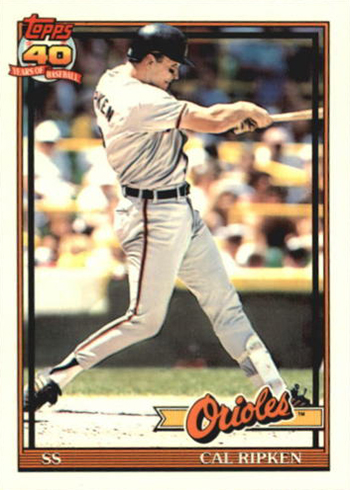
1991 Topps Cal Ripken Jr.
Yeah, it's late, the next game has already started. Give me a break I'm in North Carolina on vacation. Here's a picture of a card I know I have. Why? Because like everyone my age who collected cards I have approximately 3,345 1991 Topps cards. Man, those were the days. Five bucks would get be 10 packs or so. Every Sunday before church (yup, I haven't always been a dirty little heathen) I'd go to Lucky's and drop whatever cash I had on cards (yup, convenience stores used to carry cards back then) and then quietly rip them open some time between communion and the sermon.
Wednesday, September 25, 2019
Sunday, September 22, 2019
Orioles Victory Card Number 51: One last moment for the big guy
Baltimore Orioles Victory Number 51: 2-1 over the Seattle Mariners
2016 Topps Archives Chris Davis (1991 Topps Style)
"Davis, in the air, right field. That ball is back, at the wall, and GOOD BYE HOME RUN! Chris Davis! Maybe it's the last one at home, maybe it isn't"
On Sunday, the most beleaguered Oriole of them all, Chris Davis turned on a Marco Gonzales fastball and deposited it into the sparsely populated right field bleachers. It was only his 11th home run of the year, but it provided the winning margin in an excellently pitched game. It's the lowest total of his career since 2011, his first year in Baltimore.
His two-and-a-half year decline has been well documented, but for one last moment, in the final home game of the season for the Orioles, he provided a little reminder of what it was like during the good days. The easy swing, the electric crack off the bat that leaves no doubt, and the laconic run around the bases were all so familiar for his first five-and-a-half years in Baltimore.
Will he be back next season? It's hard to say. The best thing for the team would probably be for him to not be there. That opens up first base full time for Trey Mancini, which then opens up another outfield spot for one of the young players. If Ryan Mountcastle is ready, he can back up Mancini and DH (Mark Trumbo will likely be gone as well). The line-up becomes a little more right-handed heavy, but DJ Stewart in a full season would most likely hit more than 11 home runs.
Still, there is the issue of the $51 million left on his contract. It's asking a lot of whatever Angelos is actually running the team to pay someone that much to not play for the Orioles. Yes, the Orioles are a mid-market team (that would have you believe they are a small market team) and that's a tremendous amount of money to bury, but it's not out of the realm of possibility.
I've been long of the opinion that he is penciled onto the roster to begin the season. After all, it's still a season that fans can expect them to see them lose 100 games. Mountcastle is still a prospect without a position who has yet to take a major league at bat. Management is in no hurry to rush anyone along so they may keep him in AAA for the beginning of the season.
So Davis may have another chance to show his teammates, coaches, and the fans that he can find his stroke. Unlike last season, there were times he was on a legitimate hitting streak, even when he wasn't getting hits he was still hitting the ball sharply.
He can still play an average-to-good first base and still possess light-tower power. There are also some small milestones he can still hit, even if it's just a half-season that he plays. He's six away from 300 homeruns, 49 hits away from 1200, and 22 away from 800 RBIs. That's a pretty damn good career.
There's still a week left in the season and he should get a few more at bats. There may be one more moment in the orange and black that fans remember. If not, his last at bat in Camden Yards was a pretty damn nice one.
Friday, September 20, 2019
Orioles Victory Card Number 50: They finally broke me
Baltimore Orioles Victory Number 50: 5-3 over the Seattle Mariners
2018 Topps Chrome 1983 Chance Sisco Autograph
I've been doing this for two seasons now. I've posted a total of 97 cards over that time, way less than I thought I would have to when I started this project. In between postings I've watched a lot of losses. A lot of losses. Not that was not to be expected, especially this season.
You have to gear yourself up when you know you're looking at a 100+ loss season, especially if you want to stay positive throughout most of those losses. Still, there is a breaking point. For me it was loss 103 - the 11-10 defeat at the hands of the Toronto Blue Jays on Wednesday.
It wasn't just that they had led 7-1 midway through the game or that they went into the ninth with a 9-5 lead. It was knowing that they were going to blow it once Billy McKinney walked to load the bases. Miguel Castro is still just 24 years-old and has the pitches needed to be an effective reliever at the major league level. Yet, there are nights when he can't find the strike zone.
Wednesday was one of those nights. It was painful watching him miss with slider after slider. Even after he struck out Bo Bichette, there was no relief in tension. The Orioles had arms in the bullpen (even if Hunter Harvey had been shut down for the year). It might have been Brandon Hyde seeing how his young right-hander would react to a stressful situation. Or, he just didn't manage it correctly.
Whatever it was, it was just a bit too much for me. Even the comeback attempt in the bottom of the inning rang hollow (yes there was a slight, split second of hope that DJ Stewart's drive to right was going to leave the yard).
I still ended up watching parts of games the last two nights, but my heart isn't really in it. I'm at the point where I'm watching other games to see who I want to root for in the playoffs (probably the Rays and Dodgers) and to see if St. Louis can hold on to the division so that I can cash another bet (my Pirates bet is already good to go).
Hockey season is right around the corner as well so my attention is starting to head in that direction (nice to see the Lightning finally show up for a pre-season game). With a little over a week to go, I have enough cards loaded up to finish out this season (maybe we'll end with an even 100), but I'm not sure if I want to do this again next season.
Labels:
Baltimore Orioles,
Orioles Victory Cards,
Sad Panda
Sunday, September 15, 2019
Orioles Victory Card Number 49: Who will be hurling the ball for the Birds next season?
Baltimore Orioles Victory Number 49: 8-2 over the Detroit Tigers
2018 Bowman Prospects Hunter Harvey Sky Blue Parallel #214/499
The dream of 60 wins is starting to fade. Without a dramatic push to end the season it's unlikely the O's are going to hit the magic number of 60 wins (or even 59) which would allow me to cash a ticket in Las Vegas. That's sad. So sad. The good news is that every win puts them one better than last year which should be seen as an improvement. Some of the wins are coming with players who are going to be a part of the next year's continuing rebuild.
It's fun seeing an outfield of Anthony Santander, Austin Hays, and D.J. Stewart knowing that next year that trio could spend most of the season together. The infield is still a question mark, Jonathan Villar. Did he have a solid enough of a year to generate some interest on the trade market during the off-season? Are the O's going to sell high on Hanser Alberto or Renato Nunez? Is Rio Ruiz an everyday player? So much fun!
The biggest question marks, and the biggest obstacle to the rebuild, is going to be the pitching staff. The Orioles need to find five or six pitchers to start games next year and another seven or eight to fill out the bullpen. There should be plenty of competition for those spots.
The first three spots in the rotation should be:
John Means
Dylan Bundy
Alex Cobb
Means has had a breakout rookie season and gives the Orioles an actual left-handed starter that can win games. Bundy may have been usurped by Means as the ace of the staff, but he does seem to be adjusting to life without a 96MPH heater. Cobb has made 31 starts in the first two years of his four year contract with the Orioles. That's not great. They need him to average that many over the final two to even come close to making that deal tolerable. (I'm kidding, even if he wins the Cy Young that contract will remain brutal).
So who fills in the other two spots? Unfortunately for the fans, it's unlikely to be any of the top prospects. Keegan Aiken and Dean Kramer may get a chance with a strong spring training, but the O's don't seem to be in a hurry to rush anyone along. They may join the kids in Bowie (Zac Lowther, Michael Baumann, and Alex Wells) as mid-season call-ups. Grayson Rodriguez is a September call-up at best, well unless he treats AA and AAA batters with the same disdain as he has everyone else he's faced so far in his pro career.
It'll be interesting to see if they keep any of their waiver claims/international money trades starters that they picked up along the way this season. Asher Wojciechowski and Aaron Brooks have had moments this summer. They haven't had the consistency that I'm sure manager Brandon Hyde would like to see, but they've pitched well enough to at least have a shot next season at making the rotation.
As for the bullpen, their collective performance this season wasn't good enough. That might not be a bad thing. If Miguel Castro and Mychal Givens had continued their progression they might have been with the team after the trade deadline. They have a chance to rebuild their value next season and fill out some late inning roles.
The man pictured above (pre-glorious mullet) has injected a little fun into the bullpen late in the season. Flashing a 100 mph heater and some top-shelf breaking pitches, Harvey has shown the stuff of a future closer. Eleven strikeouts in 6.1 innings is a fun stat. The big question mark will be if his arm can hold up to an entire season's worth of pitches. So far the answer is no (87.2 innings is the most he's thrown in a season and that was way back in 2014).
He's only been a reliever for a short time, so it is possible that the move to the bullpen may keep him healthy. Harvey did go 10 days between appearances recently as the team was cautious with some forearm discomfort he was feeling. No need to risk a major injury in a lost season, but it would be nice to see him finish the season strongly.
It will be interesting to see which of the lefty relievers make the squad next year. Paul Fry has struggled recently and Richard Blier has had a blah kind of season. Tanner Scott is young and throws really hard, but he doesn't always know where it's going. He's walking 7.2 hitters per nine innings. That's not great when you're coming in for high-pressure situations.
As for the righties? Who the hell knows? The Orioles have a lot of prospects that need to be added to the 40-man roster or risk being exposed in the Rule V draft. Some of those spots will most likely come from the Chandler Stephenson's and David Hess' of the roster. Mike Elias will have a busy winter and it will be interesting to see what kind of roster he puts together in 2020.
Saturday, September 14, 2019
Orioles Victory Card Number 48: More than last year.
Baltimore Orioles Victory Number 48: 6-2 over the Detroit Tigers
1985 Topps Eddie Murray All Star
Another day and I run out of time to post. Will have something after the next win.
1985 Topps Eddie Murray All Star
Another day and I run out of time to post. Will have something after the next win.
Thursday, September 12, 2019
Orioles Victory Card Number 47: They beat the Dodgers!
Baltimore Oriole Victory Number 47:7-3 over the Los Angeles Dodgers
1981 Topps Al Bumbry
Yeah, wow. So the day kind of got away from me and I wasn't able to get a post written in time. Oh well, here's an Al Bumbry card for ya.
1981 Topps Al Bumbry
Yeah, wow. So the day kind of got away from me and I wasn't able to get a post written in time. Oh well, here's an Al Bumbry card for ya.
Wednesday, September 4, 2019
Orioles Victory Card Number 46: A Hall of Fame Last Name
Baltimore Orioles Victory Number 46: 2-1 over the Tampa Bay Rays
2003 Bowman Dustin Yount
After three series, the O's record stands at 3-5 just like I predicted! Granted they took a slightly different route, but the main thing is that they are still on pace for 60 wins. With an unexpected day off they head back to Baltimore to take on the Rangers. To some fans disappointment, the roster isn't loaded with prospects named Mountcastle, Aiken and Hays. That's not necessarily a bad thing. It's been a long, and mostly successful summer for a lot of the kids in the organization, why end it with the possibility of struggling in the majors?
Speaking of prospects, the O's have a pretty good track record of having sons of major league players wind through their system. Dwight Smith Jr. is currently on the big league roster, his pop played for the O's back in 1994. Currently Preston Palmeiro and Ryan Ripken, two family names Baltimore fans should be readily familiar with, are getting ready to hit the playoffs for Bowie along with Jesmuel Valentin, son of former major league infielder Jose Valentin.
Not all offspring succeed. The Orioles drafted the offspring of one of the greatest hitters ever, Pete Rose, only to see Jr. flounder in their minors before they dealt him to the White Sox. Pete, Jr. eventually had a brief cup of coffee in the majors with the Cincinnati Reds where he picked up two hits in fourteen at-bats during the 1997 season.
One son of a hall of famer that I forgot the Orioles drafted was Dustin Yount. In fact I spent most of the summer thinking this was a Larry Bigbie card. The son of lifelong Brewer Robin, Dustin was born in October of 1982 less than a month after his dad had gone 3-for-4 with home run and two runs batted in on the last day of the season to hold off the Orioles for the AL East pennant.
The Orioles drafted Dustin in the ninth round of the 2001 draft. He banged around the minors for a few years, getting as high as AA Bowie in 2006. He struggled in 2007 and played the next few years in independent ball before getting another shot with the Dodgers organization. Again he struggled to find his consistency and topped out in AA. He was done playing after 2010 and moved into a role with the Dodgers as an area scout.
In 2012 he scouted he a lanky first baseman from Arizona who made great contact but showed little power. That player - Cody Bellinger. Not a bad signing for an area scout on the job less than two years. He's also the scout that brought Alex Verdugo and Willie Calhoun (part of the Yu Darvish trade with the Rangers) into the Dodgers' organization. That's pretty good work.
Bellinger is an interesting case. Is he the type of player who may not get drafted as more and more clubs rely heavier on analytics as opposed to in-the-field scouting. The Orioles are the latest to gut their scouting staff (something that has happened in previous teams Mike Elias has been part of). Would a 6'4", 170lb first baseman who hit all of one home run in high school show up on a team's radar (even if he's the son of a major leaguer)?
Old-fashioned scouting seems to be passe these days.As the information age continues to spread to college and high-school players more and more teams are relying on analysts to decide their drafts instead of scouts in the field. One of the more memorable clips of the movie Moneyball was the pre-draft scene where Brad Pitt's Billy Beane looks increasingly frustrated as his scouts (including one guy with a hearing aid and another with bifocals) discuss various players with gems such as:
"An ugly girlfriend means no self-confidence"
"Clean cut, good face"
It's a visual and verbal scene showing that the old ways are out of touch.In order to be competitive, teams (especially low-budget teams) have to look at players in a different way. The main point in that scene and others is that teams didn't understand what went into winning games and therefore spent money on players (Johnny Damon in this case) that didn't necessarily contribute as much as people thought to wins.
As "Peter Brand" (a stand in for Paul DePodesta) states later in the movie,
"There is an epidemic failure within the game to understand what's really happening. And it leads people who run major league teams to misjudge their players and mismanage their teams. They're still asking the wrong questions."
Teams shouldn't be buying players, they should be buying wins. That kicked off an analytics revolution that spent the better part of the next decade trying to determine how to find players that can contribute to more wins. What leads a team to wins? Is it on-base percentage or launch angles? Range factors or WAR? It's a process that's still evolving, but it's involving a lot of things that don't appeal to some folks who have been around the game a long time. Some think the "computer boys" are ruining the way the game is played.
Yet, a player like Bellinger could be an argument that there is still value for physical scouts out in the field.An argument that an experienced scout or ex-player can see something in his 17-year-old swing and how he moves on the field that allows him to project how he will develop as as a 21-year-old? Something that an algorithm won't detect.
The answer, as it usually does for such arguments, lies in some happy middle place. Yes, the information that is out there is valuable and should be used by clubs to scout out their prospects, but there is still room for the people that drive from backwater town to backwater town and watch the games.
People seem to think it has to be one or the other and that's just not true. A team that relies solely on the old way of doing things is going to struggle just as much as a team that only relies on analytics to determine who will play for them. The most successful clubs are able to blend the two together and pick out the players that not only look good to the eye, but also produce in a way that satisfies the analytics and allows teams to project out their future to a reasonable degree.
A team that trains it's scouts to look for more than radar gun readings and home run totals is going to find the diamonds in the rough as well as the players that stand out via the eye test and the analytics readings.
2003 Bowman Dustin Yount
After three series, the O's record stands at 3-5 just like I predicted! Granted they took a slightly different route, but the main thing is that they are still on pace for 60 wins. With an unexpected day off they head back to Baltimore to take on the Rangers. To some fans disappointment, the roster isn't loaded with prospects named Mountcastle, Aiken and Hays. That's not necessarily a bad thing. It's been a long, and mostly successful summer for a lot of the kids in the organization, why end it with the possibility of struggling in the majors?
Speaking of prospects, the O's have a pretty good track record of having sons of major league players wind through their system. Dwight Smith Jr. is currently on the big league roster, his pop played for the O's back in 1994. Currently Preston Palmeiro and Ryan Ripken, two family names Baltimore fans should be readily familiar with, are getting ready to hit the playoffs for Bowie along with Jesmuel Valentin, son of former major league infielder Jose Valentin.
Not all offspring succeed. The Orioles drafted the offspring of one of the greatest hitters ever, Pete Rose, only to see Jr. flounder in their minors before they dealt him to the White Sox. Pete, Jr. eventually had a brief cup of coffee in the majors with the Cincinnati Reds where he picked up two hits in fourteen at-bats during the 1997 season.
One son of a hall of famer that I forgot the Orioles drafted was Dustin Yount. In fact I spent most of the summer thinking this was a Larry Bigbie card. The son of lifelong Brewer Robin, Dustin was born in October of 1982 less than a month after his dad had gone 3-for-4 with home run and two runs batted in on the last day of the season to hold off the Orioles for the AL East pennant.
The Orioles drafted Dustin in the ninth round of the 2001 draft. He banged around the minors for a few years, getting as high as AA Bowie in 2006. He struggled in 2007 and played the next few years in independent ball before getting another shot with the Dodgers organization. Again he struggled to find his consistency and topped out in AA. He was done playing after 2010 and moved into a role with the Dodgers as an area scout.
In 2012 he scouted he a lanky first baseman from Arizona who made great contact but showed little power. That player - Cody Bellinger. Not a bad signing for an area scout on the job less than two years. He's also the scout that brought Alex Verdugo and Willie Calhoun (part of the Yu Darvish trade with the Rangers) into the Dodgers' organization. That's pretty good work.
Bellinger is an interesting case. Is he the type of player who may not get drafted as more and more clubs rely heavier on analytics as opposed to in-the-field scouting. The Orioles are the latest to gut their scouting staff (something that has happened in previous teams Mike Elias has been part of). Would a 6'4", 170lb first baseman who hit all of one home run in high school show up on a team's radar (even if he's the son of a major leaguer)?
Old-fashioned scouting seems to be passe these days.As the information age continues to spread to college and high-school players more and more teams are relying on analysts to decide their drafts instead of scouts in the field. One of the more memorable clips of the movie Moneyball was the pre-draft scene where Brad Pitt's Billy Beane looks increasingly frustrated as his scouts (including one guy with a hearing aid and another with bifocals) discuss various players with gems such as:
"An ugly girlfriend means no self-confidence"
"Clean cut, good face"
It's a visual and verbal scene showing that the old ways are out of touch.In order to be competitive, teams (especially low-budget teams) have to look at players in a different way. The main point in that scene and others is that teams didn't understand what went into winning games and therefore spent money on players (Johnny Damon in this case) that didn't necessarily contribute as much as people thought to wins.
As "Peter Brand" (a stand in for Paul DePodesta) states later in the movie,
"There is an epidemic failure within the game to understand what's really happening. And it leads people who run major league teams to misjudge their players and mismanage their teams. They're still asking the wrong questions."
Teams shouldn't be buying players, they should be buying wins. That kicked off an analytics revolution that spent the better part of the next decade trying to determine how to find players that can contribute to more wins. What leads a team to wins? Is it on-base percentage or launch angles? Range factors or WAR? It's a process that's still evolving, but it's involving a lot of things that don't appeal to some folks who have been around the game a long time. Some think the "computer boys" are ruining the way the game is played.
Yet, a player like Bellinger could be an argument that there is still value for physical scouts out in the field.An argument that an experienced scout or ex-player can see something in his 17-year-old swing and how he moves on the field that allows him to project how he will develop as as a 21-year-old? Something that an algorithm won't detect.
The answer, as it usually does for such arguments, lies in some happy middle place. Yes, the information that is out there is valuable and should be used by clubs to scout out their prospects, but there is still room for the people that drive from backwater town to backwater town and watch the games.
People seem to think it has to be one or the other and that's just not true. A team that relies solely on the old way of doing things is going to struggle just as much as a team that only relies on analytics to determine who will play for them. The most successful clubs are able to blend the two together and pick out the players that not only look good to the eye, but also produce in a way that satisfies the analytics and allows teams to project out their future to a reasonable degree.
A team that trains it's scouts to look for more than radar gun readings and home run totals is going to find the diamonds in the rough as well as the players that stand out via the eye test and the analytics readings.
Subscribe to:
Posts (Atom)


